

The Art of Plating World Cuisine Right food may begin in the kitchen, but its final destination is a visual stage. In the realm of gastronomy, flavor matters—but first, we eat with our eyes. Across cultures, the arrangement of a meal on a plate is not merely decorative; it’s deeply expressive. As global cuisines continue to intertwine, a new aesthetic conversation has emerged—one where world plating art fuses tradition with innovation, balance with beauty.
Plating as Language: Beyond Taste
Every culture has a visual dialect when it comes to presenting food. From the intricate symmetry of Japanese kaiseki to the abundant, rustic spreads of Middle Eastern mezze, plating reveals how a society views harmony, ritual, and indulgence. In many ways, the plate is a cultural canvas, and the dish is its dialect.
In Japanese cuisine, minimalism prevails. Negative space is not a flaw, but a feature. Each element is placed with surgical intent, creating a quiet tension between color, shape, and meaning. In contrast, Indian thalis explode with vibrancy—circular trays brimming with dal, chutney, pickles, and curries. Here, the aesthetic is abundance. Thus, when it comes to world plating art, context defines composition.
The Psychology of Color
Color is not a mere visual flourish—it’s emotional architecture. The bold reds of kimchi against white rice. The saffron gold of Persian tahdig. The verdant greens of a Thai herb salad. These hues not only delight the eye but signal freshness, nutrition, and cultural symbolism.
Western fine dining often relies on complementary color theory—think of beetroot purée paired with goat cheese, or green asparagus accented by an egg yolk. Meanwhile, Southeast Asian cuisine layers vibrant colors naturally: orange carrots, purple cabbage, lime wedges, and basil leaves dance together on a single plate.
In the realm of world plating art, mastering chromatic storytelling is essential. After all, color isn’t just seen—it’s felt.
Texture as Visual Tension
Texture isn’t just tactile—it’s visual. A crispy golden edge, a glossy sauce, a dusting of crushed seeds—each element adds dimension. In Peruvian cuisine, the creamy softness of aji de gallina is often punctuated by boiled eggs and crunchy nuts. In French cuisine, silky veloutés are garnished with croutons or fried herbs to disrupt monotony.
Texture can also evoke emotional contrast. A crackling sugar crust over flan suggests luxury. A chaotic heap of fried shallots over congee implies comfort. Across cultures, world plating art uses texture not just to satisfy the mouth but to tease the eye.
Geometry and Symmetry: The Plate as Architecture
Geometry plays a central role in how different cultures plate their food. In Nordic cuisine, dishes are often plated with stark precision—linear arrangements that mimic winter landscapes. Circles, squares, and negative space create a minimalist tableau. Scandinavian chefs often lean into mathematical balance, using tweezers as brushes.
Conversely, Moroccan tagines are presented communally, where the central peak of slow-cooked lamb or chicken resembles a volcanic sculpture. Flatbreads spiral out from the dish like sunbursts. There’s rhythm in this chaos—an artful asymmetry born of generosity.
From bento boxes to banana leaves, world plating art reflects regional philosophies through form. Whether grid-like or organic, geometry on a plate guides the eye as much as the appetite.
Cultural Identity Through Garnish
In some cultures, garnish is never ornamental—it’s sacred. A sprig of coriander atop Vietnamese pho is not optional. The ziggurat of green onions on a Korean bibimbap adds both freshness and cultural intent. Mexican tacos topped with radish slices, lime wedges, and jalapeño slivers carry regional pride and chromatic harmony.
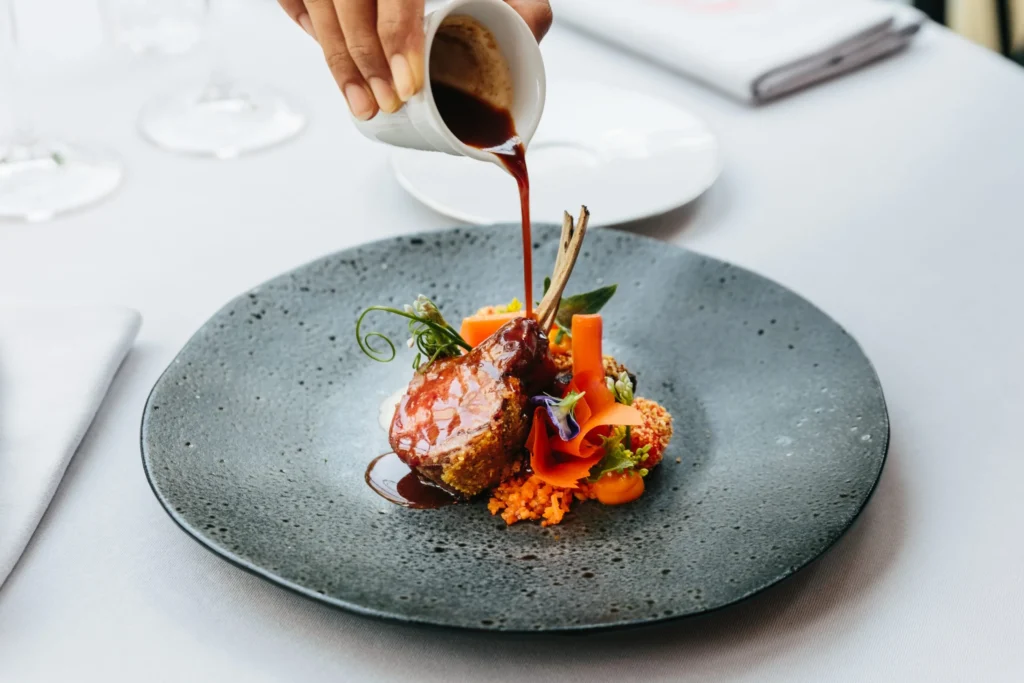
Meanwhile, in Western haute cuisine, microgreens, edible flowers, and flavored foams serve as signatures of refinement. Though they differ in function, both schools of thought understand that garnishing is storytelling.
Therefore, in world plating art, garnish acts like punctuation—shaping the tone and completing the sentence.
Vessel as Vision: Choosing the Right Canvas
The plate itself is part of the performance. It’s not neutral. Japanese ceramics often feature imperfections that symbolize wabi-sabi—the beauty of transience. Ethiopian meals are served atop injera, which doubles as both plate and utensil. In Korean royal court cuisine, brassware is used to denote prestige and temperature retention.
In modern fusion cuisine, chefs often turn to slate boards, glass panels, or hand-thrown pottery to evoke naturalism. Even banana leaves, clay pots, or wooden trays aren’t merely nostalgic—they elevate authenticity.
When considering world plating art, the vessel must complement the voice. It should frame the dish without overwhelming it, marrying form with function.
Symbiosis of Portion and Plate
Balance is key. A massive steak on a tiny plate looks desperate. A single ravioli on a platter feels like an insult—unless, of course, it’s a statement. Portioning must harmonize with plating. Japanese kaiseki excels at this, offering multiple small courses where each plate’s size and portion are calibrated to the diner’s emotional arc.
In Thai street food, however, the pile-it-high aesthetic signals generosity and accessibility. Similarly, American diner culture relishes the overwhelming—a full breakfast sprawled across a platter, unapologetically abundant.
Through this lens, world plating art must always consider scale, intention, and context. Is the meal meant to impress, nourish, or comfort? The answer dictates proportion.
Contrast, Movement, and Focal Point
The best-plated dishes possess flow. Like a painting, they guide the viewer’s eye from one point to another. The layering of color, texture, height, and sauce creates visual tempo. For instance, a Moroccan bastilla, with its golden crust and powdered sugar top, draws the eye to its layered center. A bowl of Japanese ramen, meanwhile, arranges its toppings in a radial symmetry that encourages exploration.
Plating is choreography. Each ingredient dances in relation to others. The main protein often acts as the lead dancer, supported by garnishes, sauces, and sides in harmony.
In high-level world plating art, movement on the plate echoes movement in the kitchen—deliberate, fluid, and emotionally resonant.
Symbolism on the Plate
Symbolism in plating transcends trends. In Chinese banquets, round tables and circular plates symbolize unity. The whole fish served during Lunar New Year represents prosperity. In Middle Eastern feasts, the use of communal trays and tiered serving vessels reflects tribal lineage and hospitality customs.
Food is metaphor. The way it is served reflects not only geography but philosophy. A single leaf under a sushi roll is not for aesthetics alone—it denotes seasonal awareness and attention to detail.
When executed with purpose, world plating art becomes a form of edible semiotics—a silent language of place, purpose, and pride.
The Role of Technology and Modern Trends
With the rise of molecular gastronomy and digital plating tools, culinary aesthetics have entered a new age. Spherification, edible films, dehydrated dusts, and carbonated fruits now appear as playful yet technical tools for storytelling. Restaurants like El Celler de Can Roca and Alinea have turned plates into canvases of optical illusion.
However, technology isn’t replacing culture—it’s amplifying it. A Sri Lankan curry leaf foam or a powdered Japanese miso still carry regional resonance even when shaped with modernist techniques.
As a result, world plating art today exists in a constant state of evolution, straddling the ancestral and the avant-garde.
Fusion and Respect: Plating Across Borders
Fusion plating has opened a world of possibilities. But it also requires responsibility. When Japanese sushi is presented taco-style, or when a Cuban ropa vieja is reimagined as a foam-topped tapa, the intent behind the presentation must be respectful, not exploitative.
Cultural elements on a plate should not be exoticized—they should be honored. Chefs who succeed in this arena research, collaborate, and engage with the histories behind the dishes. In doing so, they create plates that don’t merely dazzle—they educate.
Hence, ethical considerations are now part of world plating art. Beauty must be paired with integrity.
Plating as Performance
Finally, plating is performative. From the open kitchens of sushi counters to the tableside flambé, visual drama is part of the diner’s journey. Smoke under glass, sauces poured at the table, or edible centerpieces add theatricality to presentation.
Even the act of unwrapping banana-leaf tamales or unfolding a thali feels ceremonial. It signals the start of something meaningful. In this way, plating ceases to be passive—it becomes an event.
When dining becomes a multisensory experience, world plating art achieves its fullest expression—not just in taste or sight, but in presence.
The art of plating world cuisine right is not about rigid rules. It’s about reflection. About understanding that each dish is born of geography, history, and emotion—and that its final presentation is a love letter to its origins.
As borders blur and palates globalize, the plate becomes an international stage. Where saffron meets soy. Where basil rests beside berbere. And where world plating art continues to evolve—not by erasing distinctions, but by celebrating them with every stroke of sauce and every scatter of spice.
Ultimately, when food looks like art and tells a story, it becomes unforgettable. And in that perfect intersection of form, flavor, and feeling, the plate becomes more than just porcelain—it becomes poetry.